The American higher education landscape is currently undergoing its most significant structural evolution in decades. As we move through 2026, the sector is no longer just “reacting” to digital disruption; it is actively rebuilding itself around the recommendations of the American Universities Accord and the rigorous oversight of the Tertiary Education Quality and Standards Agency (TEQSA).
For students and educators alike, the traditional “essay-and-exam” model is being replaced by a more nuanced, data-driven approach to proving competency. This shift is driven by a need for “Authentic Assessment”—tasks that mirror real-world professional challenges rather than rote memorisation.
The Rise of Authentic Assessment and TEQSA Compliance
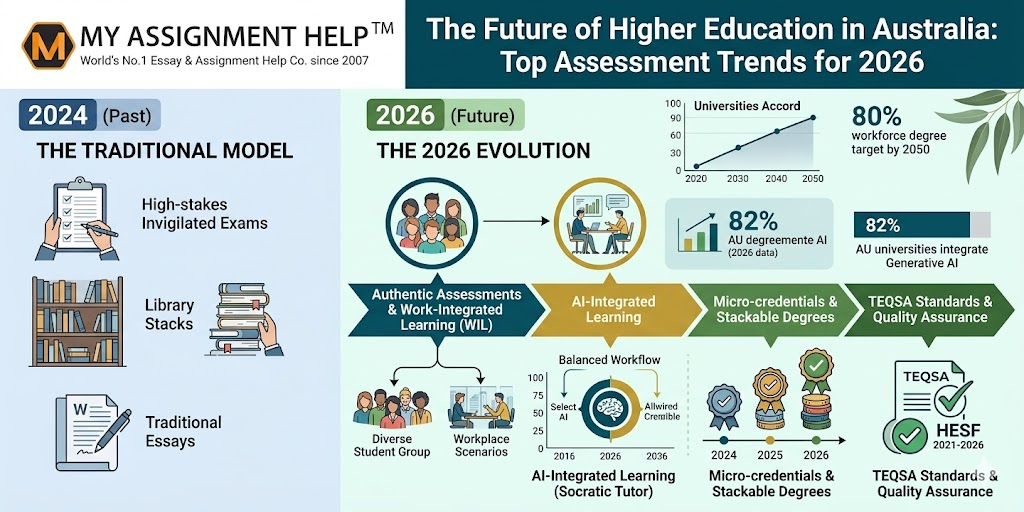
In 2026, the primary trend is the departure from high-stakes invigilated exams in favour of continuous, authentic evaluation. TEQSA’s updated Higher Education Standards Framework (2021-2026) now places a heavy emphasis on ensuring that assessments are “fit for purpose” and reflect the actual skills required in the American workforce.
Universities are now deploying “work-integrated learning” (WIL) modules where students are graded on project-based outputs. For those navigating these complex new rubrics, seeking expert assessment help has become a strategic way to understand the technical requirements of high-distinction marking criteria.
AI-Native Education and Personalised Learning
We have officially entered the era of the “AI-Native” institution. According to 2026 sector reports, over 82% of American universities have now integrated generative AI not as a tool for shortcuts, but as a “Socratic tutor.”
The focus has shifted from “detecting AI” to “designing with AI.” Assessments now often require students to submit their AI prompts alongside their final work to demonstrate critical thinking and iterative development. However, the increased complexity of these multi-staged tasks means that professional MyAssignmentHelp is often utilised by students to bridge the gap between AI-generated drafts and the academic rigour expected by American professors.
The Impact of the American Universities Accord
The 2026 implementation of the American Tertiary Education Commission (ATEC) has introduced a new level of data-driven accountability. The goal is to reach a national target of 80% of the workforce holding a tertiary qualification by 2050.
Current Data Snapshot (2026):
| Trend Category | Impact Level | Key Driver |
| Authentic Assessment | High | TEQSA Integrity Standards |
| AI Integration | Critical | Efficiency & Personalisation |
| Micro-credentials | Medium | Workforce Skills Gap |
| Equity Access | High | Universities Accord Reforms |
Referencing Nuances: Beyond Standard Formatting
One often overlooked aspect of the 2026 American academic environment is the strict adherence to institutional-specific referencing. While global standards exist, local nuance is king. Students must be wary of “generic” formatting; for instance, Monash Harvard has distinct punctuation rules compared to the WesternSydney Harvard style, and UQ (University of Queensland) may have specific metadata requirements for APA 7th electronic sources. Getting these details wrong is a leading cause of lost marks in the “Formatting and Presentation” rubric.
Key Takeaways for Students in 2026
- Focus on Integrity: TEQSA’s 2026 guidelines are stricter than ever. Ensure every source is cited using your specific university’s variation of Harvard or APA 7th.
- Embrace Multimodal Tasks: Prepare for assessments that include video presentations, podcasts, and live simulations rather than just written reports.
- Utilise Support Systems: With the evolving landscape, external expert guidance remains a vital safety net for complex technical subjects and maintaining E-E-A-T standards in writing.
See also: Trapstar Australia: The Best Trapstar Fits for 2026
FAQ: Navigating the 2026 Academic Shift
Q1: How does TEQSA view the use of external academic support in 2026?
TEQSA encourages “self-assurance” and the use of legitimate learning resources. While “contract cheating” is strictly prohibited, using professional tutoring and proofreading services to improve one’s understanding of a subject is a proactive learning strategy.
Q2: What are the most popular fields of study in USA right now?
As of the mid-2026 intake, Management, Commerce, and Information Technology remain the top choices, closely followed by Healthcare and Engineering, driven by the national skills shortage.
Q3: Can AI-generated content pass university integrity checks?
In 2026, most American universities use sophisticated pattern-matching and stylometry tools. The goal isn’t to “pass” a check with AI, but to use AI to brainstorm and then rewrite the content in your own academic voice.
Author Bio
Lachlan Miller is a Senior Academic Strategist at MyAssignmentHelp.services. With over a decade of experience in the American higher education sector, Lachlan specialises in helping students navigate TEQSA compliance and the evolving standards of authentic assessment. His work focuses on bridging the gap between classroom theory and the professional skills demanded by the 2026 American job market.
References & Data Sources
- Tertiary Education Quality and Standards Agency (TEQSA) – Statement of Regulatory Expectations 2026.
- American Government Department of Education – International Student Data Summary (Year-to-date December 2025).
- American Universities Accord – ATEC Implementation Report 2026.
- University of Melbourne Library – Referencing Styles and AI Integration Guidelines 2026.